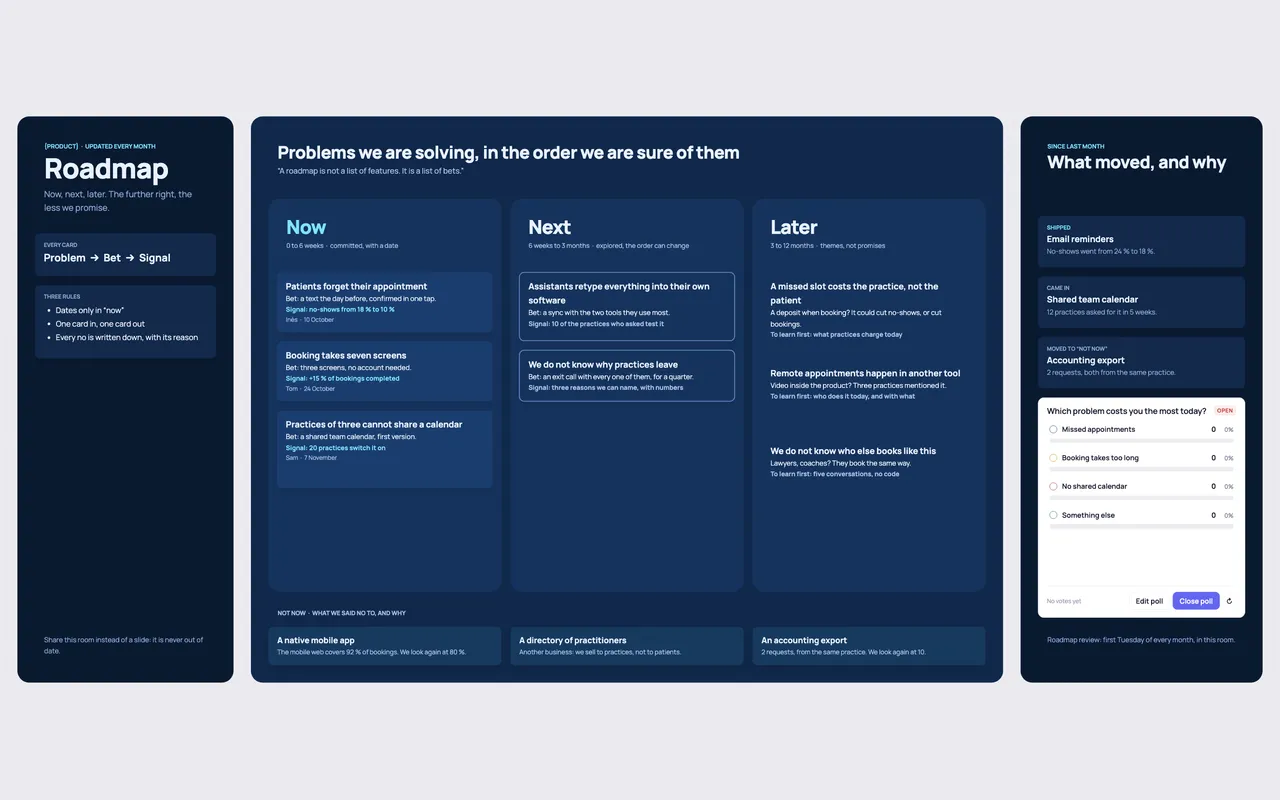
A now-next-later roadmap template lays out problems in three horizons of decreasing certainty: now (committed, with dates), next (explored, the order can change) and later (themes, not promises). The Roadmap template in Coommit writes every card as a problem, the bet made on it and the signal that settles it, and keeps a visible list of what the team said no to.
What is a now-next-later roadmap?
A now-next-later roadmap replaces a timeline of features with three columns of problems. The further right a card sits, the less the team promises about it. It is popular with small product teams because it matches how certain they actually are: sure about the next six weeks, fairly sure about the next quarter, curious about the year.
The format fails when cards turn back into feature names. The template prevents that with a fixed card shape: problem, bet, signal.
What is on the board
- The rules. Every card is Problem → Bet → Signal. Dates only in "now". One card in, one card out. Every no is written down, with its reason.
- Now: 0 to 6 weeks, committed, with a date. For example: "Patients forget their appointment. Bet: a text the day before, confirmed in one tap. Signal: no-shows from 18 % to 10 %. Owner and date."
- Next: 6 weeks to 3 months, explored. Problems with a bet and a signal, but no date: "Assistants retype everything into their own software. Bet: a sync with the two tools they use most."
- Later: 3 to 12 months, themes. Each with what the team needs to learn first: "Video inside the product? Three practices mentioned it. To learn first: who does it today, and with what."
- Not now: what we said no to, and why. "A native mobile app: the mobile web covers 92 % of bookings. We look again at 80 %."
- Since last month. What shipped (with the number it moved), what came in, what moved to "not now".
- A poll for customers or stakeholders: which problem costs you the most today?
- The ritual: roadmap review, first Tuesday of every month, in this room.
How to run a monthly roadmap review
- Start with "since last month". What shipped and what it moved. Numbers first; opinions after.
- Walk the "now" column card by card. Is the date still right? Is the signal still the right one?
- Promote or demote. One card in, one card out. If something enters "now", something leaves it.
- Write every no in "not now" with its reason and the condition to look again.
- Ask the audience. Share the room instead of a slide and run the poll with customers or the sales team.
Tips for product teams
- Write problems, not features. "Booking takes seven screens" survives a change of solution; "redesign booking" does not.
- Make the signal measurable. A signal you cannot measure turns every review into a debate.
- Keep the no list public. It is the part of the roadmap stakeholders read most, and it prevents the same request from coming back every month.
- Pair it with prioritisation. Decide what enters "now" with an impact effort matrix.
Running the roadmap in Coommit
Coommit is a shared workspace where teams meet on video around their docs, designs and websites. The room stays available after the call. The roadmap lives in a room, the monthly review happens on video inside it, and anyone you share it with sees the current version, not last quarter's slide.
Guests join from a link, with no account and no download. You can embed the spec from Google Drive or a Figma file next to a card, and after the review the built-in AI writes a recap with the decisions and the tasks, which you can send to Slack or Notion. The Roadmap: now, next, later template is available when you create a new room. See Coommit for product teams and the pricing.