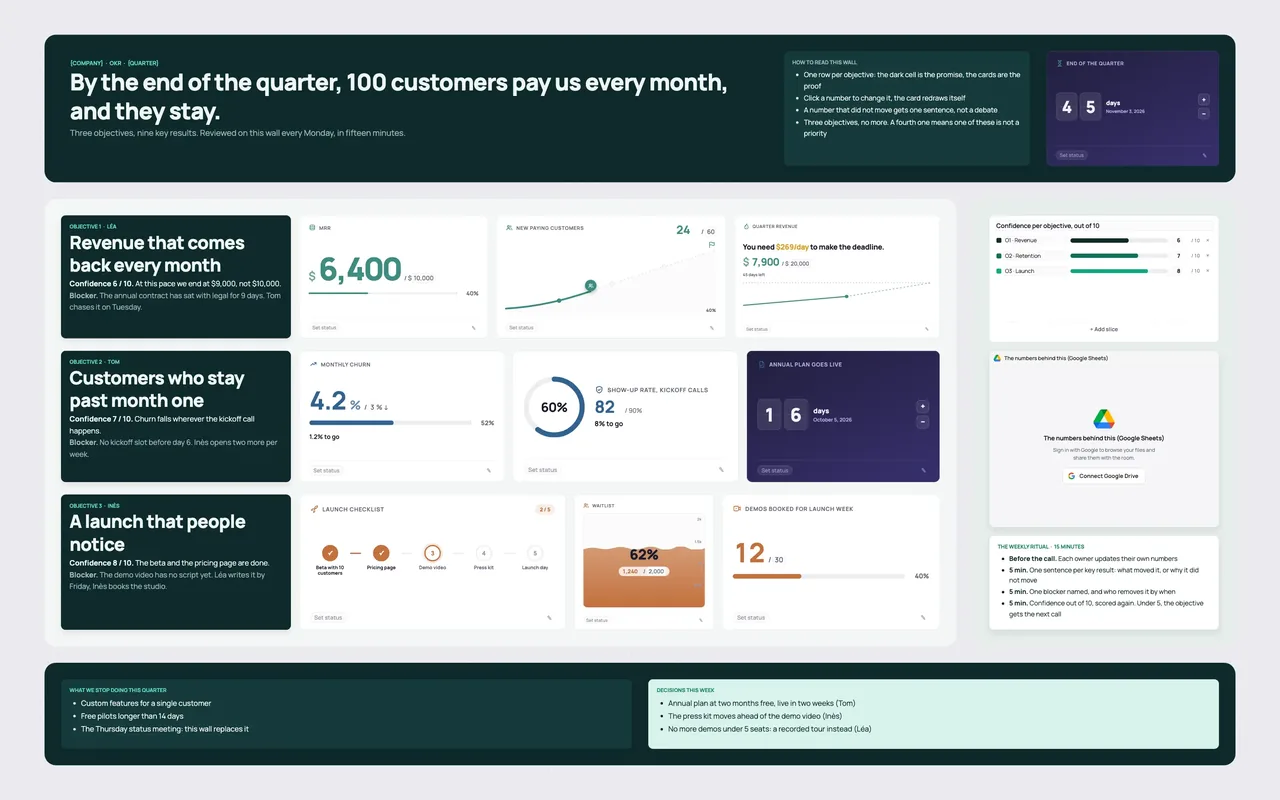
An OKR template lays out a quarter as a few objectives, each with key results that prove whether it happened. The Quarterly OKR scorecard template in Coommit puts the whole quarter on one wall: three objectives with an owner and a confidence score, their key results as live goal cards, and a 15-minute weekly ritual that keeps the numbers from going stale.
What are OKRs?
OKR stands for Objectives and Key Results. An objective says where you want to go; its key results say how you will know you got there. The method comes from Intel, where Andy Grove shaped it in the 1970s. John Doerr brought it to Google's founders in 1999, then took it far beyond tech with his 2018 book, Measure What Matters.
The objective is qualitative: "Customers who stay past month one." A key result is measurable and dated: "Monthly churn goes from 5.5% to 3% by the end of the quarter." If you cannot measure it, it is a task, not a key result.
Why OKRs fade after the kickoff
OKRs often die in the document they were written in: a page nobody opens between the kickoff and the end of the quarter. What keeps them alive is a wall the team looks at every week for fifteen minutes, where each number either moved or gets one sentence explaining why not.
How to write OKRs
- One sentence for the quarter. The template's example: "By the end of the quarter, 100 customers pay us every month, and they stay."
- Three objectives, no more. A fourth one means one of the three is not a priority.
- One owner per objective, named on the wall.
- Results, not tasks. "Launch the onboarding emails" is a task. "Show-up rate at kickoff calls from 70% to 90%" is a result.
- A start, a current value and a target for every key result.
- A confidence score out of 10, scored again every week.
OKR examples from the template
Objective 1: Revenue that comes back every month (Léa)
Key results: monthly recurring revenue from $4,000 to $10,000 ($6,400 today), new paying customers from 0 to 60 (24 so far), and $20,000 of revenue for the quarter ($7,900 so far). Confidence: 6 out of 10, because at this pace MRR ends at $9,000. Blocker: the annual contract has sat with legal for 9 days, and Tom chases it on Tuesday.
Objective 2: Customers who stay past month one (Tom)
Key results: monthly churn from 5.5% to 3% (4.2% today), show-up rate at kickoff calls from 70% to 90% (82% today), and the annual plan going live, tracked with a countdown. Confidence: 7 out of 10. Blocker: no kickoff slot before day 6, so Inès opens two more per week.
Objective 3: A launch that people notice (Inès)
Key results: a five-step launch checklist (beta with 10 customers and pricing page done; demo video, press kit and launch day still to come), a waitlist of 2,000 people (1,240 today), and 30 demos booked for launch week (12 so far). Confidence: 8 out of 10. Blocker: the demo video has no script yet, and Léa writes it by Friday.
The 15-minute weekly OKR review
- Before the call, each owner updates their own numbers.
- 5 minutes: one sentence per key result, on what moved it or why it did not move.
- 5 minutes: one blocker named, with who removes it and by when.
- 5 minutes: confidence out of 10, scored again. Under 5, the objective gets the next call.
The wall also lists what the team stops doing this quarter, such as custom features for a single customer, and the decisions of the week, each with its owner.
What is on the board
- The sentence of the quarter and a four-line guide to reading the wall.
- A countdown to the end of the quarter.
- One row per objective: the promise, its owner, the confidence and the blocker, then three key result cards, each in the style that fits what it counts (a big number, a climb, a gauge, named steps or a deadline).
- A live chart of confidence per objective.
- A slot for the Google Sheets file behind the numbers.
- The weekly ritual, what the team stops doing, and the decisions of the week.
Tips for OKRs that last the quarter
- Look at them weekly. An OKR reviewed once a quarter is a wish.
- One sentence, not a debate. A number that did not move gets a short explanation, then you move on.
- Write down what you stop. A quarter is also won by what you say no to.
- Connect OKRs to the rest. Key results feed the "now" column of a now-next-later roadmap, and a quarterly team health check tells you whether the team can hold the pace.
Running your OKRs in Coommit
Coommit is a shared workspace where teams meet on video around their docs, designs and websites. The room stays available after the call. The Monday review happens on video in front of the wall: every key result is a card from the Goals widget, you click a number to update it, and each objective's confidence sits on a live chart.
The numbers sheet is embedded from Google Drive. After the call, the built-in AI writes a recap with the decisions and the tasks, which you can send to Slack or Notion. The Quarterly OKR scorecard template, like the other meeting templates, is available when you create a new room. See Coommit for product teams and the pricing: a 7-day free trial, no card required.