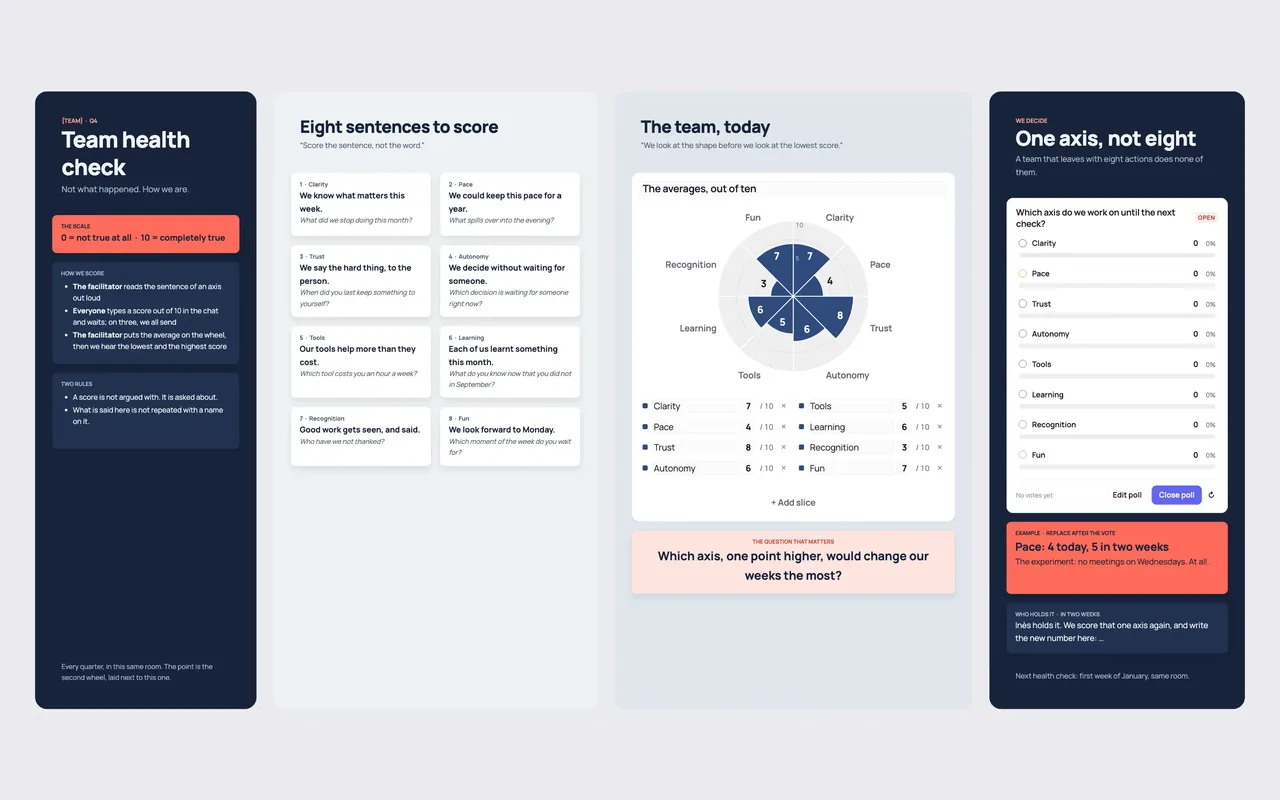
A team health check is a regular workshop where a team scores how it is doing on a few axes, looks at the result together, and picks one thing to improve. The Team health check template in Coommit has the whole team score eight sentences out of 10, draws the averages on a live wheel, and ends with a single two-week experiment and the person who holds it.
What is a team health check?
A retrospective asks what happened in the last two weeks. A health check asks how the team is doing underneath, once a quarter. The format was popularized by Spotify's Squad Health Check model, published in 2014 by Henrik Kniberg and Kristian Lindwall: about ten cards such as "Fun", "Learning" and "Easy to release", on which each squad rates itself green, yellow or red, with a trend.
The authors presented their cards as a starting point for teams to adapt. This template keeps the idea and changes the scoring: eight sentences scored from 0 to 10, so the averages draw a wheel you can compare quarter after quarter.
The eight axes and their sentences
Each axis is defined by the sentence that is true when things go well. People score the sentence, not the word, because "trust: 6" means six different things to six people. The scale runs from 0, not true at all, to 10, completely true.
- Clarity: we know what matters this week.
- Pace: we could keep this pace for a year.
- Trust: we say the hard thing, to the person.
- Autonomy: we decide without waiting for someone.
- Tools: our tools help more than they cost.
- Learning: each of us learned something this month.
- Recognition: good work gets seen, and said.
- Fun: we look forward to Monday.
Team health check questions
When the scores on an axis are far apart, a follow-up question opens the conversation:
- Clarity: what did we stop doing this month?
- Pace: what spills over into the evening?
- Trust: when did you last keep something to yourself?
- Autonomy: which decision is waiting for someone right now?
- Tools: which tool costs you an hour a week?
- Learning: what do you know now that you did not know in September?
- Recognition: who have we not thanked?
- Fun: which moment of the week do you wait for?
How to run a team health check, step by step
- Set the scale and the two rules. A score is not argued with; it is asked about. What is said here is not repeated with a name on it.
- The facilitator reads the sentence for one axis out loud.
- Everyone writes a score out of 10 and waits. In the template, people type it in the call chat and all send on three, so nobody anchors on the first number.
- The facilitator puts the average on the wheel, then asks the lowest and the highest scorer to speak.
- Look at the shape before the lowest score. Then ask the question that matters: which axis, one point higher, would change our weeks the most?
- Vote on one axis and write a two-week experiment, with the person who holds it.
- Two weeks later, score that one axis again. The full check comes back next quarter.
A team health check example: pace at 4
The example wheel reads: clarity 7, pace 4, trust 8, autonomy 6, tools 5, learning 6, recognition 3, fun 7. Recognition is the lowest score, yet the team votes for pace: for them, it is what spills into the evenings and wears down everything else.
The goal is to move pace from 4 to 5 in two weeks, not to 8. The experiment: no meetings on Wednesdays, at all. Inès holds it. In two weeks the team scores pace again and writes the new number on the board. Next full check: the first week of January, in the same room.
Spotify squad health check or this template?
Both ask the same question. Spotify's traffic lights and trend arrows are quick to read across many squads. Scores out of 10 draw a wheel, give you a number to move by one point, and make two quarters easy to compare side by side. If you compare many teams, the cards work well; for one team, the sentences give you more to talk about.
Tips for a health check that changes something
- One axis, not eight. A team that leaves with eight actions does none of them.
- Same room, every quarter. The point is the second wheel, laid next to the first.
- Protect the outliers. Ask the lowest and highest scorers for examples, not justifications.
- Connect it to the quarter. If the experiment touches priorities, give it a line in your OKR template. The same wheel logic works for one person with the wheel of life.
Running the health check in Coommit
Coommit is a shared workspace where teams meet on video around their docs, designs and websites. The room stays available after the call. The whole team scores on video, the wheel is a live chart on the board, the poll picks the axis, and next quarter you lay the new wheel next to this one.
For a large group, breakout groups let smaller teams talk before the vote. After the call, the built-in AI writes a recap with the decisions and the tasks, which you can send to Slack or Notion. The Team health check template, like the other meeting templates, is available when you create a new room. See Coommit for product teams and the pricing: a 7-day free trial, no card required.