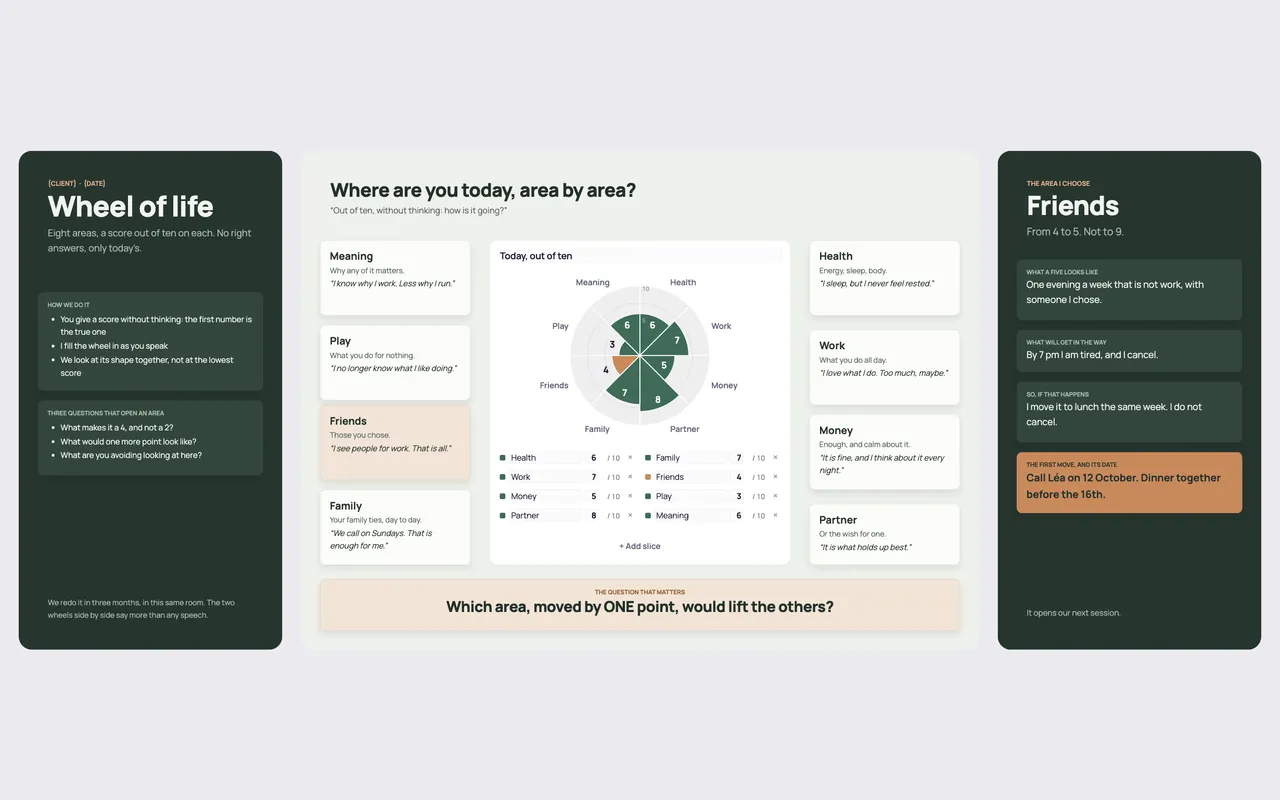
A wheel of life template helps a client score eight areas of their life out of ten, see the shape of the result, and pick the one area where a single extra point would lift the others. The Wheel of life template in Coommit draws the wheel live while the client talks, and ends on one dated first step instead of a list of good intentions.
What is the wheel of life?
The wheel of life is one of the most used coaching exercises. The client scores each area of their life from 0 to 10, and the scores are drawn as wedges of a circle. A balanced life makes a round wheel; a bumpy wheel shows where attention is missing. The exercise is quick, visual and easy to repeat, which is why coaches use it in first sessions and again a few months later.
Where it often falls short is the ending. Clients look at the lowest score and promise to fix it. The question that makes the hour worth it is different: which area, moved by one point, would lift the others?
The eight areas on the board
The template uses eight areas, each with a one-line definition and an example of what a client might say:
- Health: energy, sleep, body. "I sleep, but I never feel rested."
- Work: what you do all day. "I love what I do. Too much, maybe."
- Money: enough, and calm about it.
- Partner: or the wish for one.
- Meaning: why any of it matters.
- Play: what you do for nothing.
- Friends: those you chose. "I see people for work. That is all."
- Family: your family ties, day to day.
Change the areas if your coaching practice uses a different set; the wheel updates with them.
How to run the exercise, step by step
- Set the rule: a score without thinking. The first number is the true one. No right answers, only today's.
- Fill the wheel as the client speaks. In the template the wheel is a live chart: you type each score and the wedge grows in front of them.
- Open an area with three questions. What makes it a 4, and not a 2? What would one more point look like? What are you avoiding looking at here?
- Look at the shape together, not at the lowest score.
- Ask the question that matters: which area, moved by ONE point, would lift the others?
- Make the choice concrete. The area chosen and the move ("Friends, from 4 to 5, not to 9"), what a five looks like, what will get in the way, and what the client will do if that happens.
- Write the first move with a date. "Call Léa on 12 October." It opens the next session.
Tips from coaches who use it well
- One point, not five. A move from 4 to 5 happens this week; a move from 4 to 9 never starts.
- Plan for the obstacle. "By 7 pm I am tired and I cancel" is the most useful sentence of the session when it comes with a plan B.
- Redo it in three months, in the same room. Two wheels side by side say more than any speech. Keeping one room per client makes the comparison a scroll away.
- Pair it with a structure for the rest of the programme. The coaching session template and the GROW model template pick up where the wheel ends.
Running it live in Coommit
Coommit is a shared workspace where teams meet on video around their docs, designs and websites. The room stays available after the call. For coaches, that means the session happens on video inside the client's room, the wheel is drawn live on the canvas while you talk, and the commitments stay there for the next session.
Clients join from a link, with no account and no download. After the call, the built-in AI writes the recap with the decisions and the next steps. With the Calendly connection, a booking can create the room and invite the client automatically. The Wheel of life template is available when you create a new room. See Coommit for coaches and consultants and the pricing: one plan, and clients join free.